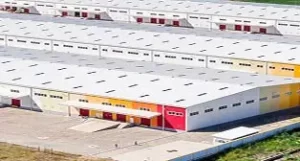
For Makhazen (the new name for Agility Public Warehousing Company KSCP) shareholders and customers, visit Makhazen.com.

Environmental Progress

Agility is committed to reducing the carbon footprint of our various businesses and working with partners across the value chain to reduce our collective impact on climate change. Each of our businesses has its own sustainability roadmap, based on its sector and the geographies in which they operate.

96% of Agility’s businesses by total headcount, representing >90%+ of total emissions, are committed to reaching net-zero GHG emissions by 2050 or earlier.

of Agility businesses by total emissions have committed to net zero.

Menzies was the first major aviation services provider to have its science based net-zero targets validated by the SBTi.

Global Quality, Environment, Health, Safety & Security Standards

Agility is committed to delivering consistently high standards of quality, service, and safety. We aim to achieve this through sustainable practices, operational resilience, environmental protection, robust processes, and protecting stakeholder assets.

Partnering For Progress

A founding member of the First Mover’s Coalition, launched by the World Economic Forum to scale procurement and development of net-zero technology. Agility is also part of the Road Freight Zero coalition, designed to advance the deployment of zero emission fleets and infrastructure by 2030.

First Movers Coalition

Read more

Road Freight Zero

Read more

Leaders for a Sustainable MENA

Read more

Environmental Management Approach

Our environmental values are consistent across the group, but our diverse businesses operate in different industries, markets, and stages of maturity. Each subsidiary develops and executes its own tailored environmental strategy, guided by group-level goals as a minimum standard. Because our companies vary in their impact and control over emissions, water, and waste, we focus on embedding strong governance and sustainability practices across all operations—ensuring every business contributes to our shared commitment to environmental responsibility.

Agility Total Group GHG Emissions in 2024

0,470 Scope 1 Emissions (Tonnes CO2e)
0,655 Scope 2 Emissions (Tonnes CO2e)
0,661,355 Scope 3 Emissions (Tonnes CO2e)

Gross Total Emissions: 2,868,479 (Tonnes CO2e)

Environmental Highlights Across Our Businesses

Menzies Aviation
  • Our largest business, Menzies Aviation, has set science-based targets to achieve net zero across all three scopes by 2045. This commitment was a first for the aviation services sector and sets ambitious milestones internally and within its value chain. In 2024 Menzies Aviation became the first major aviation services provider to have its net-zero targets validated by the Science Based Targets initiative.
  • Since 2022 Menzies Aviations’ scopes 1 & 2 emissions intensity as measured by tCO2e per $‘000 revenue has decreased more than 30%; and as measured by tCO2e by employee headcount it has decreased by over 18%.
  • Menzies Aviation has a global goal to have 25% electric ground support equipment (GSE) by 2025. Menzies takes an ‘electric first’ approach to all new GSE, wherever possible across its global operations. Menzies Aviation added over 850 electric GSE assets in 2024, achieving 22% electric GSE globally. More than 40% of GSE in Europe is electric. The company’s refurbishment and repower workshops in the U.S. Los Angeles (LAX) and Las Vegas (LAS) airports convert diesel baggage tractors to electric. In 2024 eight baggage tractor refurbishments to electric were completed, with a further 60 planned for 2025. The company can perform fully electric turns at several locations and it is on track to meet its target of 25% electric motorized GSE globally by 2025.
  • Menzies Aviation has increased use of hydrogenated vegetable oil (HVO) as a replacement for diesel. HVO is now used in San Diego, Arlanda, Gothenburg, Amsterdam, Oslo, Los Angeles, San Francisco, Santa Ana and London Heathrow with increased locations and volumes planned for 2025. HVO is a good interim step to reduce emissions while we convert our GSE fleet to electric.
  • Menzies Aviation has developed emissions reporting capability within its Air Menzies International eCommerce API product, providing its partner agents with emissions data for each shipment profile calculated using a set standard, enabling all parties to consider and choose lower emissions routing choices.
  • To reduce energy and water consumption, and environmental impact, Menzies Aviation is testing smart buildings solutions in London Heathrow Cargo and Sydney Cargo to provide energy use insights and environmental conditions indicators including temperature, humidity and air quality. Lessons learned in these locations will be applied to other operations locations in the future.
  • In 2023, Menzies Aviation made the transition to a biodegradable plastic — BioNaturPlastic™ — for its cargo operations at four US locations. During 2024 Menzies Aviation increased the use of BioNatur Plastics across the Americas region, offering a more sustainable alternative to virgin single-use plastic sheeting, with all products being recyclable and biodegradable. BioNatur is used in several of Americas cargo locations including Los Angeles International Airport (LAX); San Francisco International Airport (SFO); Baltimore/Washington International Thurgood Marshall Airport (BWI); Chicago Rockford International (RFD), Toronto Pearson Airport (YYZ), with Dallas Fort Worth (DFW) joining soon. Menzies also uses this product in Prague, Czech Republic. In 2023 and 2024 the Menzies Aviation Americas team’s use of BioNatur products reduced long-term plastic waste by the equivalent of over 9.9m 16oz plastic bottles.
  • Menzies Aviation has set a target of zero cargo waste to landfill by end 2026. The company is actively integrating circular economy practices into its operations by extending the lifespan of GSE through refurbishment programs, implementing closed-loop recycling practices for materials like uniform textiles and packaging, and recycling or refurbishing old electrical equipment, such as laptops. By reducing single-use plastics, repurposing decommissioned assets, and sourcing sustainable alternatives, we are lowering our environmental impact while enhancing operational efficiency.
  • Menzies Aviation has a target to reduce paper by 10% in 2025 based on 2024 volumes. To reach this target the company has implemented a number of impactful paper reduction initiatives within the company’s processes and systems, and paper tracking and reporting. Menzies Aviation monitors its global printing volumes monthly and its operational and IT teams work collaboratively to make technical improvements and work together drive behavioral change to support its paper reduction goals.

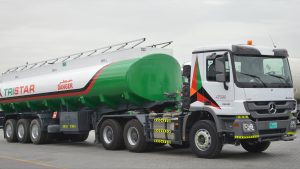
Tristar

  • Tristar is committed to 2050 net zero emissions, aligning with the UAE’s 2050 net zero target.
  • The company has seen a 37% reduction in grid-drawn electricity consumption since 2022. In 2024 a total of 3,380 MWh of electricity was withdrawn from the grid, while 1,460 MWh was self-generated through solar PV systems.
  • In 2024 Tristar consumed 174,930 liters of B100 biodiesel which reduced 466 tons of CO2e emissions. Tristar also reduced 657 tons CO2e by consuming solar PV produced energy; 66 tons CO2e from using electric MHE; and 80 tons CO2e by switching to electric vehicles.
  • In 2024, Tristar’s vessels operated below the global average carbon intensity of 0.377* tCO2e/NM, with coastal vessels at 0.077 and ocean-going vessels at 0.335 tCO2e/NM. Tristar’s ocean-going vessels have 11.2% lower emissions than the global average. Operationally, Tristar implements efficiency measures such as route optimization and hull cleaning to reduce drag and reduce fuel consumption. Tristar is also introducing a hybrid barge to its fleet, further reducing fuel consumption and emissions while maintaining operational efficiency.
  • Tristar launched its Clean Energy Division in 2023 as a new initiative to decarbonize its operations and work with like-minded partners to bring sustainable solutions to market to help achieve low-carbon transformation and net-zero targets.
  • Tristar’s decarbonization strategy is designed to significantly reduce our carbon footprint and promote sustainability across our operations. The strategy focuses on a multifaceted approach that incorporates renewable energy solutions, energy efficiency, and advanced technologies to drive environmental sustainability. The key pillars of this strategy include: Solar PV, biodiesel, fuel switching, low GWP refrigerants, electrification, water efficiency, energy efficiency, organic waste management and green hydrogen.
  • Tristar’s decarbonization strategy encompasses integrating renewable energy sources such as solar, biodiesel, and hydrogen. The company is investing in electrification initiatives, transitioning its fleet from traditional fuel-powered vehicles to electric vehicles and implementing electric forklifts in its warehouses.
  • Tristar is exploring new industry innovations, engineering technologies, and alternate fuels to improve the fuel efficiency of its vessels and reduce its carbon emission as part of the energy transition.
  • Tristar is a founding member of the First Movers Coalition, an initiative to decarbonize heavy industry. One of the coalition’s goals is to have at least 5% of deep-sea shipping powered by zero emissions fuels by 2030.
  • Tristar Group produces a variety of waste, including packaging materials, organic waste, construction debris, wastewater, and hazardous chemicals and oils. In 2024, the company generated 534,560 kg of waste, with the majority arising from operations (59%), followed by oceangoing vessels (40%), and coastal vessels (1%). Recycling initiatives, rooted in circular economy principles, have successfully diverted 297,904 kg of waste from landfills. 93% of this diversion comprised waste oil, followed by plastic waste.
  • Tristar represents the Transport and Mobility sector in the UNGC UAE Climate Action Taskforce, which consists of over 30 companies from various sectors.

Agility Logistics Parks

  • Our Agility Logistics Parks (ALP) business is building new warehousing complexes with sustainability features.
  • ALP’s Riyadh logistics park in Saudi Arabia was the first warehousing facility in the Gulf Cooperation Council (GCC) to receive EDGE Advanced certification as a green building. The construction is at least 40% more energy efficient than the national average and is a ‘zero-carbon ready’ structure. Following EDGE-certification of the Riyadh logistics park, other sites in Ivory Coast, India and other countries are in progress.
  • ALP achieved EDGE Advanced (zero-carbon ready) certification for all of its warehouses in Abidjan. It was the first warehouse company in Ivory Coast and West Africa to achieve this certification. The Abidjan warehouses have an average of 64% operational energy savings, and an average of 65% embodied carbon savings than others in the market.
  • In Mozambique three warehouses have received EDGE Advanced certifications. These warehouse have on average a 64% operational energy savings, and a 68% embodied carbon savings than others on the local market.
  • In India, a newly constructed warehouse in Bangalore has received EDGE Advanced certification. This warehouse has a 63% operational energy savings and a 22% embodied carbon savings relative to other warehouses on the local market. The warehouse includes a 1 MW solar plant. This is Agility’s third warehouse in India with a solar plant.”
  • ALP has installed a water treatment plant on site in Mozambique, where site soil conditions do not allow for traditional sewage systems and the cost of operating septic tanks is high. The ALP plant will clean up to 20,000 liters of sewage per day. The company is also adding a similar treatment plant in Tema, Ghana.
  • The ALP developments in Côte D’Ivoire, Ghana, and Mozambique have active waste management programs in operation, separating waste on site. ALP Africa is actively working to encourage and increase the availability of recycling services in each country where it operates.
A team of Alliad employees gathered in front of a cargo truck, representing teamwork and logistics services.

Alliad

  • Alliad prioritizes energy and greenhouse gas (GHG) emissions reductions, waste and water management, and infrastructure resilience. Alliad continued to focus on reducing emissions in 2024, with 63% of the company's electricity consumption powered by renewable energy. Six Alliad warehouses are now powered by solar panels in the Republic of the Congo; and camp sites are powered by solar panels where possible. Alliad's total reported GHG emissions increased in 2024 due to improved data collection and reporting. Emissions are measured and tracked in real time using digital tracking software.
  • Alliad’s comprehensive water management program ensures prioritization of water efficiency and reduced consumption where possible. The company regularly engages with suppliers, local communities and other stakeholders to implement best practice and protect water resources and it has set water consumption targets in 2025. In 2024, Alliad's water consumption decreased by 7%.
  • Alliad’s sustainability program is focusing on training employees with sustainability training modules that focus on carbon literacy; conducting an internal audit to strengthen data and reporting reliability; creating a sustainability dashboard to improve progress; continuing to roll-out its supplier management platform to better manage sustainability in procurement; and set scopes 1 & 2 GHG emissions commitments.
  • Emissions are measured and tracked in real time using digital tracking software. Camp sites are powered by solar panels where possible.

Shipa

  • In 2024, Shipa Ecommerce implemented a greenhouse gas (GHG) emissions reporting engine to log emissions and energy consumption data for each parcel and container. The company is working to integrate emissions reports from its partners into the engine, with the goal of providing regular reports to Shipa Ecommerce customers.
  • Shipa Ecommerce is partnering with a specialist waste management firm to recycle and refurbish undelivered packages.
  • Shipa Freight is partnering with an emissions calculation platform to enable customers to understand and mitigate delivery carbon footprint. In 2024, the company implemented key internal policies and launched the GHG emissions calculation and reporting platform. Going forward, Shipa Freight plans to use the platform to track customer emissions, helping them reduce the carbon footprint of their deliveries.
  • Shipa Delivery uses electric vehicles and in 2024 implemented an AI-driven route optimization tool to further reduce the company’s carbon footprint. The company will assess the results of the tool in 2025.
  • Shipa Delivery engages with suppliers and customers to reduce environmental impact. The company works its suppliers to evaluate options for integrating more environmentally friendly products and materials into Shipa Delivery’s operations. It is also partnering with a major customer to introduce hybrid vehicles in Kuwait for last mile deliveries.
  • Shipa Delivery transitioned to biodegradable pouches for document delivery to reduce plastic use. In 2024 Shipa Delivery further reduced operational plastic waste by removing all plastic bottles from Shipa Delivery offices and using recycled pouches for packaging.

Discover More From Agility